Noble and Manly Music (IV) — The Bonnie Blue Flag
“The Bonnie Blue Flag“, also known as “We Are a Band of Brothers“, is an 1861 marching song associated with the Confederate States of America. The words were written by Irish born entertainer Harry McCarthy, with the melody taken from the song “The Irish Jaunting Car“. The song’s title refers to the unofficial first Flag of the Confederacy, the “Bonnie Blue Flag, the symbol of secession from the Union, that bears the “single star” of the chorus.
We are a band of brothers and native to the soil
Fighting for our Liberty, With treasure, blood and toil
And when our rights were threatened, the cry rose near and far
Hurrah for the Bonnie Blue Flag that bears a single star!
Hurrah!
Hurrah!
For Southern rights, hurrah!
Hurrah for the Bonnie Blue Flag that bears a single star.
As long as the Union was faithful to her trust
Like friends and brethren, kind were we, and just
But now, when Northern treachery attempts our rights to mar
We hoist on high the Bonnie Blue Flag that bears a single star.
Hurrah!
Hurrah!
For Southern rights, hurrah!
Hurrah for the Bonnie Blue Flag that bears a single star.
First gallant South Carolina nobly made the stand
Then came Alabama and took her by the hand
Next, quickly Mississippi, Georgia, and Florida
All raised on high the Bonnie Blue Flag that bears a single star.
Hurrah!
Hurrah!
For Southern rights, hurrah!
Hurrah for the Bonnie Blue Flag that bears a single star.
Ye men of valor gather round the banner of the right
Texas and fair Louisiana join us in the fight
Davis, our loved President, and Stephens statesmen are
Now rally round the Bonnie Blue Flag that bears a single star.
Hurrah!
Hurrah!
For Southern rights, hurrah!
Hurrah for the Bonnie Blue Flag that bears a single star.
And here’s to brave Virginia, the Old Dominion State.
With the young Confederacy at length has linked her fate.
Impelled by her example, now other States prepare
To hoist on high the Bonnie Blue flag that bears a single star.
Hurrah!
Hurrah!
For Southern rights, hurrah!
Hurrah for the Bonnie Blue Flag that bears a single star.
Then here’s to our Confederacy, strong we are and brave,
Like patriots of old we’ll fight, our heritage to save.
And rather than submit to shame, to die we would prefer
So cheer for the Bonnie Blue flag that bears a single star.
Hurrah!
Hurrah!
For Southern rights, hurrah!
Hurrah for the Bonnie Blue Flag that bears a single star.
Then cheer, boys, cheer, raise a joyous shout
For Arkansas and North Carolina now have both gone out;
And let another rousing cheer for Tennessee be given
The single star of the Bonnie Blue Flag has grown to be eleven!
And just for fun, The Irish Jaunting Car:
————————————————————————————–
Noble and manly music invigorates the spirit, strengthens the wavering man, and incites him to great and worthy deeds. -Homer
Noble and Manly Music (III) — Polonaise in A flat by Chopin
“The Spirit of Poland”
————————————————————————————–
Noble and manly music invigorates the spirit, strengthens the wavering man, and incites him to great and worthy deeds. -Homer
Rome and the Collapse Paradigm
The collapse of the Roman Empire is one of the most notorious and most extensively studied cases of societal collapse in human history. Several causes have been attributed to having contributed to the demise of the empire, but no single cause by itself has been widely accepted as being the cause. Typical explanations are thus:
–Barbarian Invasions
–Economic Turmoil
–Religious Strife/Rise of Christianity
–Lead poisoning
–Poor Leadership
–Civil Insurrection
–Plague
But to try understand the paradigm of Roman collapse, one must look beyond single events and understand the interaction between Rome and its energy systems.
In the ancient world, nearly all power was derived from the sun in the form of agriculture. The power collected from agriculture was renewable in the sense that a certain quantity could be collected and used on an annual basis. Storing energy in this form for any substantial length of time was not possible, so society had to function within the boundaries of the yield it grew each year. During the Roman Empire, there were approximately 9 people living a rural life to every 1 person living an urban life. Today, that ratio is closer to 1:1 (in the USA, it’s 1:3). Ancient populations could not allow for such a ratio simply because of the low marginal return of human/animal based agriculture.
All of the ancient world’s social complexity- the religious institutions, the armies, the governments, the urban and nonproductive citizenry- were supported on the relatively low marginal yields of annual human/animal agriculture. This had a number of consequences, most notably that ancient society was susceptible to the effects of variants in agricultural output (weather, pestilence, soil salinization, marauders, etc). Ancient society could only exist within the limits of the marginal yield of its agriculture, but when circumstances led to a collapse of that marginal yield, so too did that society collapse. Inversely, ancient society could only solve problems within the capability that the marginal return of human/animal agriculture allowed.
Joseph Tainter in his book, The Collapse of Complex Societies, theorizes that the decline of Rome was due to a fundamental aspect of all complex societies, that the projection of social complexity among the majority of civilizations has been largely the same, that being one of increased stratification and specialization (i.e. complexity), and that eventually society reaches a point where the usual method of dealing with social problems by increasing the complexity of society becomes too costly or beyond the ability of that society.
Rome began its life of empire by rapidly conquering the Italian peninsula, during which time it expanded its territory by a factor of 100+:

Through this series of wars (e.g Samnite Wars, Etruscan Wars, Pyrrhic War, and eventually the first Punic War), Rome, like several empires throughout history, experienced the benefits of victorious warfare, those being not only increased territory, but increased revenue, slaves, plunder and resources as well. Roman expansionism in turn required increased social complexity as new regions required governing bodies and a garrison to keep the population subdued. Rome established itself as the only empire to have a consistently standing professional army. During the period following the Punic wars and the wars in Greece, Rome’s success in conquest was sufficient to fund the entirety of Rome’s operating expenses, allowing for the secession of taxation of Rome itself. Further victories against the Seleucid Empire led to Rome remaining as the last major power in the Mediterranean, which was significant during this period due to the prohibitive cost of land trade as opposed to sea faring trade.
The act of warfare itself, however, eventually became costlier as Roman borders expanded to meet stronger rivals at greater and greater distances:
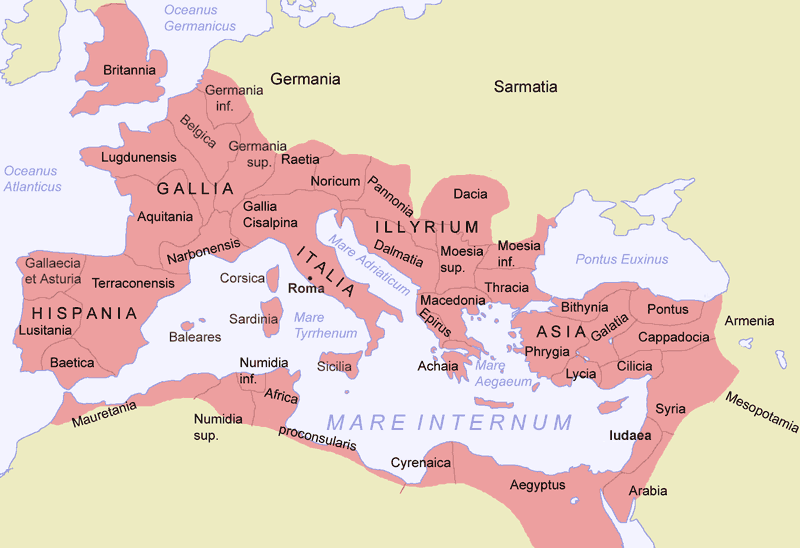
The distances , now no longer adjacent to easily accessible coastline, were making the cost of conquest prohibitive. More to the point, the enemies Rome faced as it grew larger were vast empires themselves and were more than capable of defeating the Roman legions.
It was at this point that Rome had reached a turning point: no longer would conquest be a significant source of revenue for the empire, for the cost of further expansion yielded no benefits greater than incurred costs. Conjointly, garrisoning its extensive border with its professional army was becoming more burdensome, and more and more Rome came to rely on mercenary troops from Iberia and Germania.
The result of these factors meant that the Roman Empire began to experience severe fiscal problems as it tried to maintain a level of social complexity that was beyond the marginal yields of it’s agricultural surplus and had been dependent upon continuous territorial expansion and conquest.

When Rome ceased its expansionist policy of conquest (blue) due to cold facts of cost/benefit, it lost a strong portion of its revenue (indicated by the orange ‘x’) for maintaining Roman Society. As a result, Roman emperors were forced to devalue Roman currency to simply maintain the status quo of the empire. Further economic policies included extremely excessive taxation of Roman peasantry in favor of the Roman urban citizenry and misguided attempts at controlling radical prices fluctuations. The effect of such policy, in conjunction with the intermittent barbarian raids of Roman countryside, was a gradual destruction of Rome’s capital resources: the rural population and its ability to procure sufficient energy to maintain an empire.
And as rural population declined, so too did urban population eventually follow suit:

This process of destruction of capital replaced the former action of conquest to maintain Roman social complexity (indicated in yellow):


The inevitable result of such continued policy was balkanization of the empire as not only did invasion establish new kingdoms, but so too did the Roman populace increasingly wish for relief of excessive taxation (which yielded ever decreasing benefits with the decline of the empire) in favor of simplification associated with local autonomy.
The fact is that Rome had reached a level of social complexity that it could no longer maintain. The empire was too large, had too great of a maintenance cost, with too many (increasing) problems (e.g. economic, productive, military) and too few (decreasing) resources to overcome them.
Noble and Manly Music (II) — Men of Harlech
“Men of Harlech” or “The March of the Men of Harlech” (in Welsh: Rhyfelgyrch Gwŷr Harlech) is a song and military march which is traditionally said[1] to describe events during the seven year long siege of Harlech Castle between 1461 and 1468.[2] Commanded by Constable Dafydd ap Ieuan, the garrison held out in what is the longest known siege in the history of the British Isles.[3] “Through Seven Years” is an alternate name for the song.[4] Now some associate the song with the earlier shorter siege of Harlech Castle around 1408, which pitted the forces of Owain Glyndŵr against the future Henry V of England.”[citation needed]
“Men of Harlech” occupies an important place in Welsh national culture. It is the regimental march of several regiments historically associated with Wales.
Zulu (1964) Version:
Well, they‘ve got a very good bass section, mind. But no top tenors, that’s for sure.
Men of Harlech stop your dreaming
Can’t you see their spear points gleaming
See their warrior’s pennants streaming
To this battle field
Men of Harlech stand ye steady
It cannot be ever said ye
For the battle were not ready
Welshmen never yield
From the hills rebounding
Let this war cry sounding
Summon all at Cambria’s call
The mighty force surrounding
Men of Harlech onto glory
This shall ever be your story
Keep these burning words before ye
Welshmen will not yield
Traditional Welsh Language Version:
Charlotte Church Version:
British Military Version:
Tongues of fire on Idris flaring,
News of foemen near declaring,
To heroic deeds of daring,
Call you, Harlech men.
Groans of wounded peasants dying,
Wails of wives and children flying,
For the distant succour crying,
Call you, Harlech Men.
Shall the voice of wailing,
Now be an unavailing,
You to rouse, who never yet
In battle hour were failing?
This our answer, crowds down pouring,
Swift as winter torrents roaring;
Not in vain the voice imploring
Calls on Harlech men.
Now the martial pipes are sounding,
Ev’ry manly heart is bounding,
As our trusted chief surrounding,
March we, Harlech men.
Short the sleep the foe is taking;
Ere the morrows morn is breaking,
They shall have a rude awakening,
Roused by Harlech Men.
Mothers, cease your weeping,
Calm may be your sleeping,
You and yours in safety now,
The Harlech men are keeping.
Ere the sun is high in heaven,
They yon fear, by panic riven,
Shall, like frightened sheep, be driven,
Far, by Harlech men.
97th Regimental String Version (probably closest to the original lyrics):
See the glare of fires like hell there,
Tongues of flame that writhe and swell there.
Brave men strike with full-voiced yell there:
Forward with all might.
Armor clashing, cries of foemen,
Hear the chieftains urging “On men!”
Thunder of the charging horsemen
Echo height on height.
Arfon sings forever
Of her might and glory
Wales will be as Wales has been,
So great in freedom’s story.
These fires light up the sacrifices;
Cry of a dying Welshman rises.
In the cause of freedom’s crisis
Bravest men must fight.
We’ll not die, be conquered never.
Harlech, Harlech lives forever.
Freedom’s from the Greatest Giver,
Freedom is our good.
See how Welshmen shouting run down;
From the mountains they do come down,
Like a storm that strikes at sundown
Boil up like a flood.
Welshmen’s strength has made her
Freedom’s strong crusader.
Swords of Welshmen have cut deep
The heart of the invader.
The sword is met by sword replying,
Steel by steel on strength relying;
See where Gwalia’s flag is flying,
Freedom’s in her blood.
————————————————————————————–
Noble and manly music invigorates the spirit, strengthens the wavering man, and incites him to great and worthy deeds. -Homer
Noble and Manly Music (I) — Heart of Oak
Come, cheer up, my lads, ’tis to glory we steer,
To add something more to this wonderful year;
To honour we call you, as freemen not slaves,
For who are so free as the sons of the waves?
Heart of oak are our ships, jolly tars are our men,
we always are ready; Steady, boys, steady!
We’ll fight and we’ll conquer again and again.
————————————————————————————–
Noble and manly music invigorates the spirit, strengthens the wavering man, and incites him to great and worthy deeds. -Homer
A Skeptical Look at The Venus Project
When discussing energy and economics on the internet, you will eventually come across a person or group of people who espouse a cornucopian line of thinking. One of the more common cornucopian associations is the Venus Project (TVP).
The Venus Project, Inc is an organization that promotes Jacque Fresco‘s visions of the future with the goal to improve society by moving towards what they call resource-based economy and the design of sustainable cities, energy efficiency, natural resource management and advanced automation, focusing on the benefits they claim it will bring to society.[1][non-primary source needed][2][unreliable source?] The organization was started by Jacque Fresco[3], Roxanne Meadows and Sam Laurie in 1995.[4][5][note 1] It currently works alongside The Zeitgeist Movement, which functions as an activist network, allowing members to communicate and work on projects within the movement.
The Venus Project is most notable for its appearance in the second Zeitgeist film. If you are unfamiliar with Zeitgeist, it’s content ranges from fanciful religious claims to the 9/11 “truther” movement to an international banking conspiracy to enslave the world.
One of the main tenets of TVP is a resource based economy (RBE).
Simply stated, a resource-based economy utilizes existing resources rather than money and provides an equitable method of distributing these resources in the most efficient manner for the entire population. It is a system in which all goods and services are available without the use of money, credits, barter, or any other form of debt or servitude.
The RBE idea, in reality is nothing more than technocratic communism. Typical TVP RBE talking points go something like this:
We need a current survey of all available planetary resources. The first experimental city or planning center will conduct a global survey of arable land, production facilities, transportation, technical personnel, population, and all other necessities required for a sustainable culture. This survey will enable us to determine the parameters for global planning for humanizing social and technological development, based on the carrying capacity of Earth and the needs of its people. This can best be accomplished with a constantly updated, computerized model of our planetary resources.
TVP operates on a globalist system, where nations cease to exist, borders do not exist, and all resources from any location are available to every other location on the planet. Seemingly, the only difference between Marxist communism and TVP is that TVP espouses that distribution would be handled through “technology” rather than politicians:
We would surpass the need for human participation in the production of goods and services. There is no taxation or obligation of any kind. We advocate no government by human systems. They have always proved inadequate. Computerized systems and cybernetics would be applied to the social system and must comply with the carrying capacity of our global resources.
A typical delusion of the TVP:
In 2020, I envision myself living in a self-sustained, technologically advanced city in a global resource-based economy (RBE). Politics and the notion of nationalism of the present have been long abolished, eradicating the present-day problems of corruption, crime, poverty and war. In its place, a global RBE, where decisions are arrived at through the integration of the world’s knowledge databases, enables Humanity to use its amazing capabilities to solely advance the human and environmental well-being; a far-cry from today, where decisions are usually made to benefit vested interests or based on erroneous opinions, limited by lack of information.
There are several things to address here, the most important being that the advocation that technology can and will be a solution in and of itself to the point that automation will be adopted in all major aspects of society is an emotional appeal. It’s what many people who subscribe to the belief that humanity will proceed on a path à la Star Trek want to hear. The question could be asked why would such technology only come about vis-a-vis an RBE, but as the above quote demonstrates, many TVP proponents adopt a belief that such technology is purposefully shelved and ignored for nefarious and narcissistic purposes by the “power elite”. One could ask where would such technology come from, but that will often play into the RBE proponent’s hands.
Here is a video a TVP advocate put up in response to critical attacks on TVP’s seemingly fantastic (i.e. delusional) visions:
Throughout the series of 6 videos we are shown some fabulously intriguing technology, that when taken on the face, may come across as substantiating the view that the technology TVP asserts may indeed exist. However, what should be noted is the propaganda like format of the videos. What is shown are beautiful pictures of the technologies in question accompanied by inspiring music, as well as some technical points here and there. What is not shown are any scientific peer reviewed studies of the technology in question. Only the positive aspects are addressed. There is no mention of cost (to be addressed in a bit), nor of resources, nor of involved labor, nor of return ratios (e.g. investment, energy, etc). This speaks to a larger psychology of people who fall for a cornucopian viewpoint: they want to hear the positive and never the negative, and it is from this that they establish their beliefs.
Another typical TVP proponent (quoting Envirotech):
The wave of the future is a monetary-free, open-source, efficient and environmentally friendly global culture.
The old generation of scarcity-based thinkers, oil and banking tycoons will die out and a new generation of efficient technology based global thinkers will take over.
The sun shines 24/7. The sun does not charge for it’s shine. Let’s harness that FREE energy for the well-being of everybody on this planet.
Technology is here! It’s now!
Aside from the ambiguity of the reference to the sun shining 24/7 (That the sun may be a continuously active ball of nuclear fusion does not mean that the sun is shining at any given point continuously.), there’s also a false claim made that solar energy is free, which fails to account for material, labor, R&D, and energy costs to produce not only the solar energy collectors themselves, but also the associated infrastructure that would be required to operate and distribute the energy.
The second issue with “believers” of TVP is the concept of scarcity vs abundance. From TVP’s website:
At the beginning of World War II the US had a mere 600 or so first-class fighting aircraft. We rapidly overcame this short supply by turning out more than 90,000 planes a year. The question at the start of World War II was: Do we have enough funds to produce the required implements of war? The answer was No, we did not have enough money, nor did we have enough gold; but we did have more than enough resources. It was the available resources that enabled the US to achieve the high production and efficiency required to win the war. Unfortunately this is only considered in times of war.
What the above quote demonstrates is a belief that money is the inhibiting factor in production. Unfortunately, what it also demonstrates is a typical logical fallacy of composition. While the above quote may (or may not) be true for that instance, it’s applicability beyond the example is not shown. A second error with the above quote is the idea that the United States did not have enough money. That is absolutely untrue. Equivocation is also abused when the term United States is confused with what was meant to be said: the United States government, for the government of the United States was certainly having financial constraints during the outset of WWII. However, the United States as a country certainly had the money to finance the construction of warplanes. Nor did the United States government have the resources at hand , it was the nation at large that had access to the resources. The shortcoming was the government’s ability to procure adequate funding to allocate resources for the purpose of constructing warplanes, and not as the above quote asserts, that resources were not being exploited by the United States due to lack of money, for indeed they were being exploited, however not for the purposes of constructing warplanes for the government.
It is from unsubstantiated beliefs such as the one shown above that TVP bases the idea that scarcity is merely a artifact of the monetary system, and not due to allocation and physical constraints. Look again at how this viewpoint actually reveals itself to be a belief that a utopia could be achieved if it weren’t for an “engineered society” designed to subjugate humanity:
With scarcity forever abolished through the careful management of the world’s resources as the common heritage of all the world’s peoples, the use of money has been phased out, freeing Mankind from employment. Consequently, professions that deal with finance such as bankers, lawyers etc will be come obsolete. Likewise, following the trends of the last 100 years, automation will almost completely displace human labour from having to provide goods and services to society. As such, Mankind has the unprecedented opportunity to pursue any intellectual, scientific or artistic endeavour. At the same time, the engineered consumer society has faded away since the need to generate perpetual profit via constant consumption has been made obsolete. Henceforth, all products will be made with the best possible materials with the most advanced methods. Any planned or unplanned obsolescence designed in products to fuel cyclical consumption will be remembered as a distorted concept in human history that simply wastes resources.
Notice the verbiage used in the above quote, particularly the idea that humanity needs to be “freed” from employment. The outlandishness and nearly Utopian like description of their vision is typical RBE propaganda designed to appeal to what they believe people want to hear: that the future can be rosy and wonderful, but only if we do xyz. As demonstrated by the previous quote, faith and belief plays a large part in the typical RBE advocate’s viewpoint. What’s not typical of an RBE/TVP viewpoint is skepticism. Skepticism is a large part of scientific foundation and methodology, and so it should be observed whenever critiquing proposals such as TVP. What the TVP/RBE requires is faith. Faith that technology can solve our problems. Faith that scarcity is not an issue. Faith that the entire globe can and will accept a technocratic communist state. However, reality is not obliged to contain that which one believes or has faith in.
Implied scarcity and substitution methodology are often used to defend the idea that scarcity is contrived. The idea of implied scarcity goes something like this:
“Corporation A” sells product X. Product X is necessary for social function. If “Corporation A” implies that product X will be more scarce due to a manufactured reason, then “Corporation A” may see greater profits by doing so, even though the reason for scarcity was false.
The idea of substitution methodology is an extrapolation of the observation that as resources perceptibly become scarce, new methods of production or alternative resources are used to offset the effect of [perceived] scarcity.
Implied scarcity may be true to an extent, however what has done far more damage to society than implied scarcity is an implied abundance. It was the idea of abundance that was largely responsible for the tremendous waste of resources during the previous century, and it still continues today. Examples are the constant references to “hundreds of years of resources left” implying that current trends of growth and lack of conservation are acceptable. If TVP propositions called for strictly conserving the dwindling natural resources of the planet, they’d be moving in the right direction, however that is not one of TVP’s talking points. Instead, the usual cornucopian nonsense is spouted that there are plenty of resources and/or that technology can substitute for them. Yet, neither the arguments for implied scarcity nor for substitution methodology themselves dismiss the probability of resource scarcity nor of diminishing marginal returns associated with increased complexity. It should be noted that for most problems, there are solutions. However, it is a question as to whether the cost of the solution is worth the benefit. This is particularly poignant when the cost is being demanded of one aspect of society (or region), but the benefit is largely for another. What this is is wishful thinking designed to pander to those who don’t want to change or question their ways of living, to the optimists, and to those who refuse to acknowledge the implications of resource scarcity.
The aspect of a unified globe under TVP is another point one should be skeptical about for a number of reasons. Using the example of oil, for instance, we have a commodity that modern civilization is absolutely dependent upon, however that resource exists in select regions around the globe in finite quantities. In a global RBE, those finite resources are allocated out of their native countries to the rest of the globe with a return that is not congruent with the volume of export. What is witnessed is a drainage of regional wealth for global benefit (also known as redistribution of wealth).
The process for determining what projects receive resources and attention is going to create disunion and competition. Although I would potentially support a rationing measure of resources, doing so is not going to be an attractive feature. What if one segment of society was so persistent in obtaining resources for a certain need, but the rest were not willing to allocate the appropriate resources? Putting this situation on a global scale is going to increase the potential number of such instances. Here’s a thought. Let’s say a region of extensive forest is asked to provide timber to the rest of the planet. The region, by providing timber would have a marred landscape. Why should they submit to this, especially when there are no benefits for doing so? This type of situation can be multiplied across the planet, for whatever need for a resource or resource harvesting you can imagine. Unity in such an instance is going to be very difficult to achieve.
For a global RBE to even be remotely possible without rebellion and dissolution is a conversion of identity from regional/ethnic/national to a global identity. One should be extremely skeptical on that point, as one should be with the idea that society would continue to function with no reward system (e.g. monetary) for foundational sectors of mundane employment (of course there would be robots to do that).
Once again taking a skeptical perspective, if TVP did not live up to it’s claims of a work free world, how would society manage to value goods and services with the abolition of the evil monetary system?:
Many will argue money isn’t evil and that it’s people that misuse it or are corrupted by it. This sadly isn’t so. The system we exist in is the problem, for as long as currency dominates our thought patterns we have an attachment. This creates an imprisonment psychologically and arguable spiritually.
The usual response to the question is some vague variation of automation/computers dictating production levels:
Technology intelligently and efficiently applied, conserves energy, reduces waste, and provides more leisure time. With automated inventory on a global scale, we can maintain a balance between production and distribution.
Yet even with this “system” a numerical value is going to be placed on goods/services in some fashion because even in an RBE, you need some way of comparing the value of goods, be it the caloric value, the energy cost, or the value of the cost of human labor for production purposes. Even if the individual person was totally and completely aloof from decision making in regards to value, something, be it a robot/computer or a governmental body will still be applying values to things and making decisions about the direction of society based upon those values. It just so happens that is exactly the purpose of a monetary system (and there are ways to address the issues of debt/credit expansion beyond doing away with the monetary system altogether).
As a final note, a resource based economy is entirely capable of existing, and should TVP proponents wish to live in an RBE, there is nothing stopping them from doing so. The standard of living within the RBE is based entirely on the availability and allocation of resources, but not on the resources themselves (e.g. one does not need oil to have an RBE, however having oil adds to the standard of living within the RBE). What the typical RBE advocate actually wants is a form of “having their cake and eating it,too.” They wouldn’t want to live in an RBE that didn’t have doctors, so to them, it couldn’t exist without doctors, much like they could live in an RBE where there weren’t robots designed to feed, clothe, and shelter them and where those things would have to be supplied by the participants, but then that would mean a decline in the participants standard of living, so to the proponents, it couldn’t exist until the whole world was subsumed to their “vision” (and thus be able to maintain their living standards).
The Bleak Future of Oil Exploration
An offhand comment from a geology undergrad friend of mine brought up an interesting topic. He mentioned Exxon recruiting geology grads, and it reminded me of a point that was brought up on oil issue driven forums around the oil price crash of 2008. That point was that oil exploration has evolved drastically over the years to the point where an enormous amount of technology, money and resources are being expended to find oil that is often of decreased quality, smaller reservoirs, and more difficult to reach. The result is a declining marginal return that results in companies choosing to underfund further exploration and production.
BP’s Deepwater Horizon was a good example of the amount of investment that oil companies are willing to put up nowadays (The rig itself was estimated to cost $560 million). Then there’s the cost to operating cost of the rig (approx $410,000/day) and the corresponding wait for a successful exploratory wellhead.
The fundamental problem facing oil markets at present it this: while present supplies are sufficient to meet present weak demand, these sources of production face rapid decline. The current low oil prices are not sufficient to support the long term investment in future supplies, conservation, and consumption efficiency that will be necessary to mitigate the impact of this decline. Because of the time-lag between a sufficient price signal and oil reaching the market (or demand being reduced), and because of the impact of the recent price collapse on producer psychology, volatility will rapidly increase as the market’s price signal must make increasingly exaggerated moves to bring supply and demand into equillibrium.
Then there’s the issue of potentially under performing wells:
BP’s Thunderhorse platform, described by Whipple as the “poster child” for deepwater oil production, began operation in 2008 with an expected production of 1 billion barrels at a rate of 250,000 barrels per day. The project started off well enough. By January of 2009, production peaked at 172,000 barrels per day, but then rapidly declined to 61,000 bpd by last December. Since then, BP has refused to say what is happening at Thunderhorse. One presumes it isn’t going as expected.
Oil discovery has long since passed its peak:

What this means is that it makes more sense from an economic perspective for oil companies to consolidate rather than pour increasing amounts into production avenues that are yielding less than anticipated results. The bottom line is what counts among business that is accountable to shareholders. If a better bottom line means producing less oil and not expending more on discovery, then that is what will happen. This is especially true when economic pressures cause a price collapse of the commodity.
Continued exploration and new production avenues will require higher prices to give an incentive and a proper cost/benefit ratio. Until prices reach sufficient levels (most likely approaching pre collapse levels as that’s the level these companies’ operating assumptions were based off) and be sustained at those levels, further expansion of production capacity will not occur. It’s simply not in these companies interest to do so. High prices mean more profit. Less exploration means a smaller operating cost and hence a greater bottom-line.
UrgentEvoke Archive: A Question of Scale
Original Post: http://www.urgentevoke.com/profiles/blogs/a-question-of-scale
————————————————————-

“Don’t you hear ‘em out there? It’s block war, man!” – from Judge Dredd, a dystopian depiction of the human “behavioral sink”.
Section 1… The Spark
Pandemic influenza was the topic of week nine of urgent evoke, and although influenza is a very real and dangerous threat, it was not the real threat of the comic. The enemy was not the flu, but rather one “Citizen X” who was supposedly scare mongering about a pandemic flu. It was a crisis of “information” or so it was put in the comic strip. Forgive me, but I’m calling foul here. So… we are asked to accept that the motive for Citizen X was… to cause a breakdown in societal function, resulting in the potential deaths of millions? And that he supposedly wants to go on to “destroy evoke”? Ok… whatever lol. Is this really the best these authors can come up with? Unfortunately, I don’t believe that this is simply a case of bad script writing.
We’re given the impression through the comic that the influenza is not a pandemic, but that the x-man is being a bad boy and somehow spreading massive lies about the extent of the disease. Ok… so… the media outlets are… inept? People can’t, oh I don’t know… verify these details? Ever hear of something called the internet? It’s “grade A” bull****. Rumors are nothing new, and people rarely panic when panic is not warranted. These people know damn well it’s denial that people are susceptible to, not panic, which leads me to ask: why the focus on what they call “misinformation”? What is that really about? It is a form of fostering denial.
Let’s make a supposition. Let’s say that the pandemic in the story was indeed a pandemic and that the problems associated with the pandemic were real, and not the misinformation of Mr. X-man. What exactly is to be done in that event? Well I’m sure certain people would just love for there to be a ready means to deny the situation. And wouldn’t it be great if we could forcibly silence these “bad guys”? We couldn’t have a panic on our hands, could we? No? Couldn’t happen? Well let’s think about this: why, during a supposed panic, is one of the characters playing the locals, trying to get them to accept loans? It’s not as if that is pertinent to the situation at hand. All it comes off as is trying to take advantage of a fearful situation. So I have to ask: is the problem the flu or the flu scare? If it’s the former, then why the implied push for “counter information” (which in my mind is simply denial)? If it’s the latter, then why the talk about “loans” and “micro finance”? Seriously, W…T…F does that have to do with a ****ing flu? Are loans the way the World Bank deals with a God **** flu?

If people are at the point where they’re panicking, along with all the associations of panic (e.g. looting, rioting, general mayhem), then that panic is usually justified. Other people panicking is justification enough for people to panic (i.e. rational panic). The denial of panic-inducing information (via a “dark site”… ugh, can’t they come up with a name that doesn’t patronize us?) is nothing more than a band-aid solution. It may be one that’s ready to go at the flip of a switch, but the idea is inherently reactionary, whereas the goal should have been a proactive one.
Section 2… The Question
So what exactly is the problem? The comic would like you to believe that it is a hysterical reaction (panic) to a perceived problem (influenza). So why is it exactly that crowds are reacting hysterically? The cause the comic would like you to believe is misinformation. The solution provided is one of spreading “accurate” information (i.e. propaganda) and denying misinformation (i.e. denial). Question: If the “misinformation” portrayed in the comic suddenly becomes accurate information, is panic warranted?
So why do people panic? I previously mentioned that other people panicking becomes justification for panic, but again the question is why?
Quote:
[One] theory suggests that, in crowded and disrupted populations, it is increasingly important for members to be able to predict crises and danger, which requires that each individual keep all other members of the population in view. Altmann (1967) has pointed out that the survival of social animals often depends upon instant recognition of, and correct response to, the social signals emanating from other individuals in the group. Thus, in critical social situations it may become necessary to crowd together to increase the probability of receiving important social signals as rapidly as possible. In other words, the individual who is not constantly in touch with the group may miss some essential social cue. It is at least reasonable to expect, therefore, that crowding may stimulate more crowding.
Here’s the challenge: Does a band-aid type response of denying misinformation actually solve a crisis, particularly when the underlying cause is ignored? Which brings me to my next issue… what is the underlying cause? Hypothesis: The underlying cause is a combination of factors resulting from the growth of population density; most notably a correlation between regressive behaviorism (i.e. attributes of the “behavioral sink”) and population density as well as the increased inter-linkage associated with a dense population.
Section 3… The Investigation
“Men, it has been well said, think in herds; it will be seen that they go mad in herds, while they only recover their senses slowly, and one by one.” –Extraordinary Popular Delusions and the Madness of Crowds
Population density has been a growing part of humanity with the rise of civilization, and indeed, even recent trends towards urbanization are more and more obvious. This is due to the cost/benefit ratio associated with urbanism. Certain benefits are accrued as population density increases, for example lower distribution costs and centralized management. More than that though, population density is an impetus for increased technological and social complexity, more so than either resources or simply a high population. This theme was explored here.
Quote:
The process of endogenous technological change […] may also be influenced by population density. For instance, a country with a large population may not possess a higher growth rate of technology than a country with a medium sized population, because the population density in the second country is higher. This may be true because the need to invent new technologies […] will be higher in the second country, compensating for the disadvantage of having less inventors in absolute terms. The speed of communication, the diffusion of knowledge, and division of labor could also be higher in the second country, which could lead to a faster pace of technological progress than in the more populous country […]; or higher population density increases the effective market size and thus raises the returns to innovation. This is not only theoretically plausible but supported empirically by cross-country growth research (e.g. Gallup and Sachs, 1998; Bloom at al. 1999; Nestmann, 2000).
[…]While population increases the number of potential suppliers of new technology, population density generates the linkages, the infrastructure, the demand, and the effective market size for technological innovations.
The article goes on to explore historical trends of population density and regions of the world and the corresponding technological progress, which supports this theory. In a phrase, population density’s attributes are increased networking and resource share, which, when combined with the demand created by increased population density, assist in the progression of societal and technological change.
However, increased population density also has its costs, starting with an eventual decline of benefits:
Quote:
The influence of population density on technological change is positive but decreasing over time. The transfer of knowledge is faster, the higher population density becomes, but note that the speed of this transfer is not unlimited. Although the absolute value still increases over time, the marginal increase of the growth rate in technological diffusion declines. For a single country, its own level of technology may, at lower levels of population density, also be more influenced by population density than at higher levels.
But population density does not only represent the diffusion of technology but also the need and the ability to use a new technology. […] Once the infrastructure has been built [for technological change], the influence of population density is concentrated only on the diffusion process and less on the demand factors and the basic infrastructure necessary for efficient technological spillovers, which could account for the falling marginal returns from population density. Moreover, if population density becomes too high, the costs of selecting the right information increases and this could lower the benefits of a faster knowledge transfer. The inference from the empirical evidence, which lead to a positive but declining influence of population density on the growth rate of technology is consistent with these arguments.
More troubling problems arise with increased social interaction all on its own. The question is one of: Does contact breed conflict?
Quote:
In his book Division of Labour in Society, Durkheim elaborates on his theory: “The closer functions come to one another, however, the more points of contact they have; the more, consequently, are they exposed to conflict. The judge never is in competition with the business man, but the brewer and the wine-grower often try to supplant each other. As for those who have exactly the same function, they can forge ahead only to the detriment of others (Durkheim 267).”
One case study aimed at answering that question was John Calhoun’s studies of mice in enclosed environments and increasing population density. Disturbing trends arose with increasing density (and hence increasing societal interaction):
Males became aggressive, some moving in groups, attacking females and the young. Mating behaviors were disrupted. Some males became exclusively homosexual. Others became pansexual and hypersexual, attempting to mount any rat they encountered. Mothers neglected their infants, first failing to construct proper nests, and then carelessly abandoning and even attacking their pups. In certain sections of the pens, infant mortality rose as high as 96%, the dead cannibalized by adults. Subordinate animals withdrew psychologically, surviving in a physical sense but at an immense psychological cost. They were the majority in the late phases of growth, existing as a vacant, huddled mass in the centre of the pens. Unable to breed, the population plummeted and did not recover. The crowded rodents had lost the ability to co-exist harmoniously, even after the population numbers once again fell to low levels. At a certain density, they had ceased to act like rats and mice, and the change was permanent.
[…]As population density increased it became ever more difficult for an individual to control the frequency of social contact. The result was unwanted interaction, leading to adverse reactions such as hostility and withdrawal, and ultimately, to the type of social and psychological breakdown seen during the latter stages in his crowded pens.
Section 4… The Analysis
The term “behavioral sink” was used to describe the regressive behavior of the mice as a culmination of individual erraticisms:
The behavioral sink is not a pathological behavior per se, but a sort of para-pathology, which seemingly appears from, and supervenes upon, the behavior of individual animals within the crowded group. (44) The way Calhoun describes it, behavior becomes more and more erratic until, eventually, the behavioral sink emerges like a vortex. Thereafter it acts as an accelerant, exacerbating the effects of the other pathological behaviors: “The unhealthy connotations of the term are not accidental,” Calhoun wrote, “a behavioral sink does act to aggravate all forms of pathology that can be found within a group.” (45) It is important to note that the behavioral sink was not inevitable, but emerged as a consequence of individual rats and mice becoming so used to contact when eating and drinking that they begin to associate these processes with the presence of others. By altering the feeding arrangements to reduce social contact, Calhoun found he was able to prevent its development. Without the sink, crowding was less lethal, but remained grotesque: infant mortality in severely overcrowded enclosures levels out at about 80%. With a behavioral sink, that figure skips to 96%. (46) Crowding pathology, therefore, was not dependent upon the behavioral sink, but it seemed to mark a point at which the animals are overwhelmed by the crowding, leading to a societal state-change.
The behavioral sink, as a description of crowd behavior, came to represent the culmination and exhibition of the erraticisms of individuals, multiplied by the societal interconnectedness associated with “crowds”. “The crowd had long been associated with pathology: with mass panic, with the spread of disease, with political radicalism, aggression, and unruly social behavior.” Could panic be an attribute of the “behavioral sink”? Biologically, social networking serves a purpose of acting as an alarm for potential problems. Examples of this are abundant in nature and I would suggest that humans are no different. What’s interesting here is that the very reasons for increased population density (increased societal interaction) become the problem that is being addressed. The solution begets the problem. “The only known counter to the effect of the behavioral sink is to reduce the frequency and intensity of social interaction.” This means reducing social complexity.
Regression is a form of simplification. It is the shedding of complex constituent aspects of an ordered society. The results of regression are aspects now associated with the behavioral sink: panic, rioting, looting, mass hysteria. This recalls the idea of the diminishing marginal returns of complexity: when complexity no longer confers benefits greater than simplification, society will regress.
So what does this have to do with the flu? In this case, the influenza becomes a physical manifestation of our apprehension for (and the hazards of) excessive social interactions. Greater complexity (i.e. social interactions) does not yield greater benefits than the regressive behaviorisms of the behavioral sink. People naturally would want to isolate themselves to avoid possible illness and if necessary will even go to such lengths as looting if the perceived benefits are worth it. Panic, being a rational act when others are panicking, further exacerbates and spreads such behavior. The result is a rise in the regressive erraticisms of individuals spread across a “crowd” (i.e. the behavioral sink).
The question now asked is: Can the increasing social networking of urbanism solve the problems caused by increased social networking? The band-aid solution must either try to increase the benefits of complex social interactions beyond that of regressivism or must at least give perceived benefits (i.e. lying). A “dark site” (or denial) could act as a band-aid solution if it at least accomplishes that latter goal.
Perhaps what this really is, is a question of scale. Where can the benefits of social density coincide with simplification to a point that regressive erraticisms of the behavioral sink no longer are appealing? Is the answer further complexity… or not?
-Iron Helix
————————————————————————————————————–
Addendum #1
Quote: Are you familiar with behavior correlations between humans vs mice? If this is your area of expertise, what do these results really mean? Can the be taken as writing on the wall?
Humans differ from mice in that they are better able to handle excessive social interaction through something called “conceptual space”, which is just a way of saying they have the ability to make a mental effort to ignore and/or limit interactions. However, it has been hypothesized that even conceptual space has its limitations. For instance, conceptual space may work fine in a home of 5 people, but not in a home of 50 people. Schools, hospitals, confined ships, and particularly prisons are the usual examples of where conceptual space has its limits.
In the instance of a pandemic flu, where social interaction is poisoned by the hazard of illness, being in an environment that is just tolerable with the idea of conceptual space, becomes completely intolerable both physically and conceptually. The response is often one of creating more “space” both physically and conceptually.
@ A.V.Koshy
Thanks for your insights and response. Sure, accurate information obviously has its place, and inaccurate information can be harmful. The response to information, be it accurate/inaccurate/good/bad, however, is largely similar and follows the pattern I described in my post. The act of dispersing from cities during the event of a pandemic flu is one of creating physical and conceptual space where previously the lack thereof had proved to be hazardous. People’s particular responses to such an event are often unable to be anticipated, you are correct, and they can vary from person to person. I would postulate, however, that human response, like most things, is also a form of scale. If you apply enough pressure to a situation, I would believe that you would get a certain, repeatable response. Telling a group that one person among them has the common cold will not yield the same response as telling them that one person among them has Ebola. The further down the scale of pressure placed upon physical and conceptual space, the greater the correlation of the erraticisms of the “behavioral sink”. During instances where these erraticisms are expected but not witnessed, it may simply be a matter of time at issue combined with the perceived belief that the pressure will eventually be relieved. As for the comic, I don’t really take it seriously. I just hope other people do not as well.
Addendum #2
What i found humorous about act nine was the quote: Isinzi nti be sha. The crowd does not lie — Burundian proverb
So if the crowd does not lie, what does that say about the crowd panicking? The “crowd” is simply a response to stimuli. To try and control a response is indeed futile, because for it to be effective in the long run, you would have to have foreseen every stimulus and created a plan for such contingencies. Civilization as we know it exists only because of the expense of constant controlled responses of increasing the complexity dynamic. Instead of ameliorating the effects of every stimuli society comes across (at great expense) through increased complexity and “band-aid” responses, perhaps what is needed is an application of the stimuli by society for the purpose of “hardening the individual” (as opposed to softening the blow).
An example of this kind of thinking is the typical greenhouse plant. By providing a greenhouse environment, ideal conditions are made for plant growth and productivity. Successive generations of greenhouse plants become more adept to the environment of the greenhouse. However, if the greenhouse environment is lost, either by the plant being removed from the greenhouse, or the greenhouse being destroyed in some fashion, the plant’s survivability is minimal. What was meant to be a way of creating ever more productive plant life ends in complete loss of the genetic strain of what was inevitably a fragile existence. Outside the greenhouse, plant life continues, as having been constantly exposed to harsh conditions, it must adapt to an equally harsh environment (the stimulus). Thus, in the end, hardening of the individual (stimulus) ends in a more prolonged success than simply softening the blow (response).
Addendum # 3
Quote: but i want to stretch it further
stimuli cant be foreseen there are too many
disasters waiting to happen cant be foreseen there are too many
responses cant be foressen they are too many
0-0
I see where you’re going. Usually I try to avoid making statements like that, although I may agree with them. I do so because it’s a form of arguing the unknowable, and the unknowable is always a certainty (strange statement I know). However, this particular unknowable has a certain conclusion aspect about it, a conclusion of “why bother?”
At this point, the conversation becomes less about society and more about metaphysics, and for me it verges on the cusp of what I consider insanity, hopefully not due to a lack of logic, but due to a conclusion that when thoroughly accepted questions the very meaning of existing.
While you read this, I suggest listening to some Jefferson Airplane, because that’s what I’m listening to as I write this. It puts you in the mood.
Let me start by saying that the purposes to which we apply actions are very superficial, and in a way, when you want to get at the heart of an issue, as I have tried to do with my blogs, you must address these superficial explanations for human motivation. We eat. But why do we eat? Because we want to continue to exist? To eat again? Is it because of a biological impulse? The pain of not eating? Do we eat simply to ameliorate the pain caused by our biology if we don’t?
Let’s say we have a person. His name is Robert. Robert represents the whole of humanity. Robert has suddenly become sentient. He is acutely aware of his existence and has a strong sense of what he calls the “self”. Himself.
Robert is now faced with a situation. He’s hungry. He knows, as a sentient being, that if he does not address this issue of “hunger” the being referred to as the “self” will cease to exist. Robert would like to keep existing, for no reason in particular, except for perhaps a slight fear of not existing, so he must feed. He gives himself about a couple weeks before his lack of nourishment leads to his ceasing to exist.
With great effort and ingenuity, Robert manages to kill a wild beast to consume. Robert, for the time being can continue to exist. Shortly thereafter, however, Robert is faced with an immediate and physical threat. In this case it’s a lion. Robert must either defeat the lion or cease to exist. Robert could choose to not put in the effort of defeating the lion, but Robert still enjoys existing. He enjoyed the emotions he felt in pursuing an endeavor (killing a wild beast) and consuming its flesh (satisfying a biological desire which also elicits an emotional response). He relished in the memory of a victorious moment, a tribute to the brief existence of the “self” up to this point. Robert has made a decision to keep existing, so he expends an effort into defeating the immediate and physical threat of the lion. Roberts existence has just increased from the brief few seconds until the lion would have killed him until the next unknown threat Robert is faced with.
Further threats and challenges are asked of Robert and he must respond to each lest the being known a “self” cease to exist. Robert, having existed as a sentient being for some time has come to appreciate the emotions elicited from his biology more and more, to the point where it is largely his raison d’être. These emotions encompass love, hate, fear, respect… all emotions. But these emotions are due to his biology, much like the need to feed and the pain of not feeding was also an aspect of his biology.
The number of scenarios that could lead to the extinction of humanity are extensive to say the least. Robert must overcome them all. But what happens if he doesn’t? What happens if Robert is unable to cope with…
A virus?
Nuclear war?
A comet?
A gamma ray burst?
Genetic breakdown?
A change in the structure of matter?
A decomposition of physical matter?
Each one he overcomes garnishes him a greater period of existence. But when one does him in, can it be said that it was even worth it to fight that lion from way back when? Does it matter if the ceasing of the “self” was due to a lion, nuclear holocaust, or the crumbling of physical matter? The result is inevitably the same. There are only differences. One is time. And what can be said about that time difference? What was it that made it the duration that it was (or will be)?
Biology.
What was the second difference? The number of people experiencing that biology. Is that the goal? The purpose of existing? To increase the time span and numbers of the “self”?
Here’s more. What if, somehow, the “self” was able to exist in perpetuity. Robert has overcome every possible threat to his existence. He has achieved what some may consider as deification. He has gained control of existence as we know it. What then? What is his continued purpose to exist? Looking back, does Robert now care whether or not he ceased to exist because of a lion or a blackhole?
More interestingly, what if at some point, Robert (and the whole of humanity) chose not to exist?
Reflecting on myself, I come to the conclusion that the purpose of my existence is such that I contemplate… my existence. I like to contemplate existence in certain comfort. If I were a hunter on the Serengeti a few thousand years ago, I might be contemplating more on my next meal than the meaning of existence. Modern society has provided many luxuries to my life, but they really add no more meaning to my life than the next meal of the person on the Serengeti. At most, they can only prolong my existence. Biology drives me to continue to exist, but at the end of the day, even biology has its end. What drives existence then? Is the purpose of existing to contemplate existence? Is that insanity?
Socrates was quoted as saying, “The unexamined life is not worth living.” Certainly I can agree with that. What I wonder though, is even the examined life worth living? At some point, is it worth it?
Do we really just eat… to eat again? To [insert action here]… to [insert action here] again?
Is humanity really so different from the bomb from the movie Dark Star?
http://www.youtube.com/watch?v=qjGRySVyTDk
http://www.youtube.com/watch?v=g_47mmt5SZY&feature=related
We know we’re going to explode one day. What difference if it’s now or later?
These questions disturb me on a level more profound than any other question I have yet come across, which is part of the reason I try to avoid the topic.
UrgentEvoke Archive: A treatise on the meaning of Evoke, from a pessimistic perspective
Original post: http://www.urgentevoke.com/profiles/blogs/a-treatise-on-the-meaning-of
For those who are not familiar with UE, it was a site where people could blog for points on the issue of the week. The website catered to optimists, children, and the generally naive. After a certain time there, I decided to add a bit of pessimism to the mix. I had just recently finished Joseph Tainter’s book: The Collapse of Complex Societies, so it influenced heavily on the article below.
—————————————————————-
Subtitled: An explanation as to why I’m a Doomer.
“There’s a great, big, beautiful tomorrow
Shining at the end of every day
There’s a great, big, beautiful tomorrow
And tomorrow’s just a dream away”
Friends, bloggers, fellow Evoke agents, lend me your eyes.
I am writing this blog to expand upon the very purpose of Evoke. No doubt you already have an idea as to its purpose as defined in the mission statement, or in the result of actions taken by the members of the community, but I want to apply a theme to the overarching concept of Evoke and all similar communities and their raison d’être.
Plainly put, that theme is maximization. Human population exists on this planet with varying levels of comfort (i.e standard of living), but that population already has the requirements for merely existing. The goal of many here is to maximize the standard of living among those that are just above existence levels (as perhaps opposed to subsistence or more ideally, flourishing). The methods they seek to use vary in type and scope, but regardless of the method, they almost invariably have one similar characteristic. They seek to solve a problem without removing the need for a solution.
Before I expand on that thought further, I first want to address the premise of solutions. Human society exists largely for the purpose of pooling resources to solve problems. The problems that face human societies are innumerous in quantity and infinite in scope. Sustainability, it can then be said, is never a point that is reached. Sustainability means always solving new problems. Sustainable society can never reach stasis. But why solve problems at all? Human society, like any system, has an input/output ratio. The input aspect consists of the ability of society’s population to procure energy (i.e. the means of support). The reason I say energy, and not ‘goods and services’, is because everything in this universe utilizes some aspect of energy. Energy is the underlying basis of all resources and actions of a population. The output aspect consists of all the benefits that society confers to the residing population (either real or perceived). The population largely agrees to provide input into society because the benefits they receive back are worth the time, effort, and physical resources that input requires. When the benefits of a society no longer exceed that of the input required, two things can happen. The society can either coerce the population into continuing with an unfavorable ratio of benefits/cost or the society can choose to no longer pay the cost demanded for the continuation of that society. The result is a collapse in the complexity of human society and the loss of the benefits that society conferred.
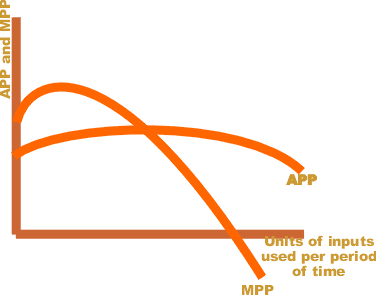
The progressions of societies largely follow the same trajectory, that being one of diminishing marginal returns.
http://upload.wikimedia.org/wikipedia/commons/2/28/Average_and_marg…
I will use the analogy of an oil field, it being a very good example of raw energy, to describe a system that is based upon the exploitation of energy. This idea was excellently covered in Chris Martenson’s video linked here: http://www.chrismartenson.com/crashcourse/chapter-17b-energy-budgeting
When an oil field is discovered, it uses energy in the processes of discovery and creating infrastructure, yielding an increasing margin of return (profit) as the field is increasingly exploited. As some point along the timescale of an oilfield, however, the rate of growth of the margin of return ceases to increase, and begins an inexorable decline of surplus energy. When the margin of return reaches a point where it takes one unit of energy to extract a unit of energy (i.e. the margin of return is zero), there is no reason to further exploit the oil field and production ceases. All the benefits that were yielded from this system of surplus energy are lost with it and the capital resources (the left over energy resources now not being invested into further production) are usually cannibalized. Now let’s overlay the idea that society, also, as a dynamic input/output system based on energy experiences diminishing returns. Upon experiencing a problem, society seeks solutions. The solution that is easiest and cheapest is usually the one that’s used first. The marginal return of the benefit/cost ratio of simple solutions for simple problems is usually very good. But growth or time itself will bring about more complex problems, in turn requiring an increase in the costliness of the solution. Organizational structure and complexity of society increases as each problem/solution also increases in complexity.
Society thus engages in a process, where an increase in complexity and organization is constantly needed to maintain a system being faced by more complex problems, but yielding an ever decreasing marginal return (surplus) to be able to deal with such problems. Societies may come across innovations for new sources of energy, as was the case with coal, oil, fission, etc, in which case the marginal return graph may have multiple “humps”, but in the end, there is an inevitable decline in the marginal product.
The law of diminishing returns applies across the board, to virtually all aspects of human societies, old and new. It even applies to the very strategies of problem solving. So the R&D process of solutions increase in tandem with the complexity of problems/solutions themselves, furthering the cost upon society at large. Solutions to declining marginal yields, it can be said, have marginal yields themselves and declining marginal returns are formulated by the decisions to choose less costly solutions prior to more costly ones. The very progression of society is from simple to complex. A few examples would be farming rich, fertile fields before marginal ones, or exploiting light, sweet crude oil before heavy, sulfated crude oil, or fishing rich areas of the sea before poor ones, etc. That’s why I find the idea of simple solutions to problems of increasing complexity so silly. There is [almost always] never a simple answer, only a trade off of costs and benefits.
When the marginal product in society begins to decline, by definition that society will be commanding a declining surplus (as a percentage of input, although as a quantity, it may be greater than in the past) and at the same time will have to be allocating an ever increasing portion of the energy budget simply to maintain organizational institutions (brought about as solutions to previous problems). With every advance, the difficulty of the task is increased and society is less capable of providing subsistence in the future. The result, in the words of Malthus is that “…exponential growth is needed to maintain constant progress.”
Human societies are victims of their own success. Society trends towards complexity and a marginal productivity with an increase in specialization/differentiation. They do this because the benefits outweigh the cost. But the very process of increasing complexity requires increased amounts of energy and resources and greater integration and organizational hierarchy. The result becomes a positive feedback loop where succeeding in solving problems only creates more damning problems down the road. Yes we can give everyone access to fresh water, and yes that is a good thing, but the increase in population also means an increased strain on resources. This increase in population impacts on other segments of society that otherwise may have been stable, but now require even greater resources and new solutions. Maybe it is possible to empower women across the globe to be man’s equal in society (again, obviously a good thing), but now you are increasing resource consumption of a large percentage of the population upwards, again creating further strain. Every solution has unintended consequences. Dr. Albert Bartlett addressed this thought when he so aptly pointed out that the very aspects of society that we admire (health care, safe food & water, traffic laws) all contribute to increasing the population strain, whereas those we don’t admire (war, famine, disease) relieve the stress. The very existence of complex society has allowed human population to exceed that, which would never have been otherwise attainable. That’s why the phrase “the road to hell is paved with good intentions” is so applicable.
The movement towards sustainability largely ignores that even “sustainable societies” collapse. History is actually rife with it. From Rome to the Mayans, they all were relatively sustainable agricultural civilizations. Their energy, in the form of food crops, was entirely renewable, and it let them last hundreds of years. But even sustainable societies are susceptible to the accumulation of stresses. These cultures didn’t decide to increase complexity (e.g. raising larger armies, or increasing peasant taxes, or debasing currency, etc.) because they wanted to or because they were stupid. They were forced to do so or face the dissolution of society. Regardless of the problem (and people can point out all the specific problems they want to, but it doesn’t matter), they would have faced an infinite number of problems, requiring ever-greater complexity, in turn requiring ever-greater energy. Equilibrium in human society does not exist. There will always be one more problem to overcome that requires the balance to be shifted.
The absolute worst aspect of those who attempt to be sustainable, but miss the big picture, is the desire to maximize the evolutionary process of marginal yield (i.e. taking complexity as far as it can go for maximizing actual yields [of numerical quantity as opposed to maximized marginal yields which create surplus, i.e. breathing room, valued as a percent]). They want to make sure everyone has… whatever, pick something; it really doesn’t matter. The end result is an increase in population and in turn increases impaction on other areas. Maximizing the marginal yield process for maximum actual yield of quantity leads to no margin of error or room for expansion, hence upon the need for a solution to a new crisis (or even simple productivity fluctuations), current sustaining product must be undermined (capital resources are cannibalized) simply to attempt to solve a problem. The result is inevitable collapse of societal structure.
Collapse of societal structure becomes a logical choice to members of a societal population when dissolution from society results in a greater marginal profit in their lives (or in a subset society). Extreme costs for sustaining society (i.e. maintaining the status quo) means collapse becomes the economical solution and concurrently declining marginal returns makes increased complexity less attractive. Joseph Tainter, whose works I have largely based this thesis on, pointed out that the paradox of collapse is that a drop in complexity yields a rise in the marginal return on investment and that “under a situation of declining marginal returns, collapse may be the appropriate response… whereas economic intensification is not [an understandable response].”
To avoid collapse and try to maintain some semblance of stability, society will often choose to endure a situation of unfavorable margins of return, as previously stated through coercion. The result is an increase towards social tyranny. Tyranny exists in this situation to prevent the dissolution of key pillars of society, who would otherwise have chosen to reject complex society in favor of the increased margin return of simplification. This partially results from the broader part of society refusing to accept a loss of complexity in their own lives (either justifiably or not). Societal hierarchy, to solve both issues of breakaway core aspects of society, yet hazardous internal disaffection as a result of loss of surplus marginal product per capita, adopt tyranny, that both suppress through force, yet appeases through the “bread and circuses” model. In this instance, sustaining society does not confer freedom or liberty, which may have been the lure into the society. Originally, population members may have been allowed the liberty to do things within society because of the excesses of the marginal return. They did so in a preference to the dangers of an anarchist lifestyle, in terms of productivity, health, and physical safety. The idea was that the large leeway in freedom to do something, while having the safety nets of society was preferable to having total and complete freedom (to do anything, right or wrong), but having a shorter, and often violently abrupt lifespan. The irony is that as society progresses into declining returns, there is also a declining amount of freedom (cost), but not a comparable increase in safety/lifespan (benefit), and the population is left choosing between being “damned if they do and damned if they don’t.” Look around you. If you live in a first world nation, & especially the United States, that should be obvious.
Collapse of society in today’s world, as it was in societies of the past, means a collapse of the population that societal structure supports. This is the conclusion I have reached, and it’s not one I have taken lightly. The difference between collapse today and collapse of the past, as proposed by Joseph Tainter, and concurred with by myself, is that collapse this time will be global. There is a subtle reason for this, and I will illustrate it using an analogy of several communities on an island. Let’s say there are 5 of them. Four of them many would consider sustainable. Their population is at replacement levels. They grow enough food for themselves to eat comfortably and perhaps then some. Every other aspect of society is at a quality where it has no impact upon population. But in the last tribe, their population growth is quite large, and they frequently face crises where they do not have the means to support themselves. They may first attempt to ask for assistance from the other tribes and the tribes just may subsidize this tribe’s behavior, perhaps out of humanitarian reason, or perhaps out of fear. At any rate, there will come a point where that tribe will not be able to support itself and the other tribes will either be unwilling or unable to give assistance. The result, as proven historically is a violent confrontation of acquisition of another “tribes” resource base. Assuming the behavior yet goes unchanged, this will continue until the whole island system collapses. Even if it had not been violent, or if the problem had not been one of population, the result would have eventually, given enough time, been the same as a crisis impacts one group, forcing it to confront another. The tribe(s) suffering the crises could have chosen to collapse to a level where marginal return was great enough to weather the storm, but doing so, especially in a situation where other tribes face similar problems (or they may not, but might simply have a growth behavior where expansion into the collapsing tribes base is a ‘solution’) means the possibility of being subjected to the domination of other groups who refuse to collapse alongside of you. As put by Tolkien: “It needs but one foe to breed a war, and those who have not swords can still die upon them.” What really factors into the equation is the concurrence of problems (which certainly affects global society today), for that is what is (and has in the past) driving competition as opposed to cooperation. The thing to draw away from this is that no society in today’s world is going to accept a collapse strategy (e.g. as espoused by Richard Heinberg in Powerdown) over a continued escalation of the social complexity dynamic, even if returns become unfavorable. The mere existence of other states becomes the reason for continued complexity. As put by Tainter: “Competition makes controlled collapse unfavorable, making unfavorable marginal returns favorable.” This continues until the whole world is faced with problems that are beyond the scope of society to solve, leading to a rapid global collapse. This time, the cost will most likely be measured in billions of lives.
This is the purpose of Evoke, and all similar communities, who like broader society, seek ways to solve problems of ever increasing cost and complexity to avoid what is inevitable collapse. They seek solutions for problems that inevitably, given enough time (and I don’t think that much more time is going to be needed), have no permanent solutions. The problem is the need for the solution. There is no way to achieve that without collapse of much of what society holds dear. If collapse is indeed inevitable, then my hope is that it comes sooner, rather than later, if for no other reason than to reduce human suffering and environmental cost. And that is why I am a Doomer.
-Iron Helix
Man has a dream and that’s the start
He follows his dream with mind and heart
And when it becomes a reality
It’s a dream come true for you and me
So there’s a great, big, beautiful tomorrow
Shining at the end of every day
There’s a great, big, beautiful tomorrow
Just a dream away!”
Addendum #1: Some of the comment responses for the article:
A)
Quote:
—————————————
With Malthusians I agree: there is a limited amount of resources and raw and everything else comes from them and inventions can´t change that. Yet I disagree with the simplistic approach that high poopulation and high density will ALWAYS go against the availability of resources and standards of living. For example Monaco has the highest population density in the world and also one of the highest standards of living http://geography.about.com/od/populationgeography/a/popdensity.htm
—————————————–
(perhaps it´s Bangladesh so again there is no simplistic answers)I’m posting this from a comment I made in another blog:
A point that I was trying to make, but may not have come across as clear, was that population is a big factor in society, yes, but it’s not necessarily the root problem. More importantly, the problem is a lack of surplus energy to support that population. When a society is not kept in check as to having a sufficient marginal return (i.e. margin of error) to overcome problems, then those problems will overcome society. Applying that to population dynamics in today’s societies, population growth does not yield a corresponding growth in surplus energy but rather a decline in available energy per capita, meaning human society is less able to cope with future problems by having more population. That does not mean that human population couldn’t grow or be at today’s levels, but for that to be the case, that society needs to have sufficient surplus energy (i.e. marginal yield) for future problems/solutions and the complexity increase required. Today, energy returns are at a precipice. Population has been allowed to grow without adequate support. The margin of return on energy in the future (for whatever reason you want to give) is looking to be less than it is now or even during the past; this is also coupled with a peaking of supply production (peak oil, peak coal, peak uranium, peak top soil, etc). Again when referring to energy, I am using the term in a broad sense. It can apply to many critical aspects of society: energy supplies (of course) food, water, disease control, etc. If future margins of return are looking slimmer, but population in turn is growing, that means a larger population having a smaller margin of error. At some point, that will not be allowed to continue (either voluntarily or involuntarily).
If this were a computer simulation, and there was a cheat for infinite energy, then population would have, for all intents and purposes, an infinite marginal yield (and thus a very large safety net), and would even be able to grow under that circumstance since increasing population does not affect the marginal yield and the corresponding societal functions… that is to say so long as there are no other limitations (which there would be of course).
B)
There are always alternatives, but that largely depends upon what your goal is.
If the goal is to increase the population’s lifespan and its standard of living, then that’s largely contrary to easing the strain that population is causing on societies’ surplus. Of course it would be ideal if you could do both, but if we’re already at a point where marginal yields are well into decline, with little prospect of that getting better, due both to the increase input cost as well as a decreasing ability to pay that cost, then trying to accomplish both will actually solve neither and will only have increased the cost of society through the increase of complexity while attempting to solve the issues.
Optimists will often adopt the cornucopian model to get around this. The Venus Project is a good example of cornucopian thinking. When presented with this issue, the easy solution is always unlimited energy, because with unlimited energy you can both increase the benefits of society and lower the cost (unlimited energy begets cheaper energy).
The real world does not work that way however. Accepting the premise that with a limited supply of surplus energy at our disposal, we can do two things. We can either use our diminishing surplus to attempt to maintain the energy supply society requires (e.g. through alternative energy) or we can use it to maintain the increasing cost of the benefits of society. Doing both would be counter productive, as ‘new energy’ is consumed by ‘new benefits’, and the marginal yield decreases further, eventually to a point where society is no longer worth supporting.
The only true sustainable option is sacrificing benefits, for sustaining the benefits first requires the energy to do so, and unless drawing down your energy supply until the marginal yield is zero is the plan, only focusing on maintaining the marginal yield through new energy subsidies makes sense. The next serious question is how well the population will take a loss of benefits, for that largely means a loss of lifespan and standard of living. Unless society is going to be adopting a coercion method of enforcing cohesion during a loss of benefits (i.e. an unfavorable margin of return), I fail to see how society will be able to increase the energy supply margin (through an additional energy subsidy of renewable technology) without collapse of the whole system and the population along with it.
If a dictator was placed in control of the world (and that’s not something I would readily support, believe me), I bet a lot could be accomplished to mobilize the remaining surplus of society to continuation (e.g. enforcing renewable investment, forcing people to have an increased part in food/water production, decreasing the excesses of certain areas of society, controlling population growth, etc.). But I have serious doubts as to whether a totalitarian model would be successful in maintaining control. It goes against too much of what society (particularly 1st world) has espoused as values (e.g. liberty). You should ask yourself how much [freedom] you would be willing to sacrifice to avoid a collapse situation. Myself, I can’t imagine it happening, but there is no way to hold on to what has been built without it. Hence my firm belief that the result will be a collapse that results in a large loss of life. There’s the chance that might not happen, but it would require either an evolutionary monolith in energy procurement (e.g. feasible fusion) or a coercive, totalitarian system enforcing the acceptance of loss of benefits yet attempting to expand the surplus margin in the area of renewable technologies to subsidize the declining margin in conventional energy.
An optimistic hope would be that everyone already recognizes the situation and voluntarily decides to cut back on societal benefits and accept a lower lifespan/standard of living, while yet agreeing to contribute greater amounts to the maintenance cost society requires. If the human race had a hive mind like bees, I could see this happening… maybe. But then again… I’m a pessimist.
C)
Quote; “The thing that must be considered is that in turn you propose population control through elemenating those who are not benificial. ”
Where exactly did I propose to eliminate people? What I was saying was that continued population growth in society does not equate with growth in the energy returns for society. At some point, and I believe that point has already been reached, continued growth leads to a decreased ability for society to sustain itself. “Eliminating people” is not going to fix that. If anything, I’d imagine it would only hasten collapse. One hopes that population levels will level out on their own, and there may be some evidence for that, at least in some areas of the world.
Quote: “My only problem is that your assesment that Rome was sustainable. In actuality Rome fell for several reason and the primary one was that they over extended economically and roman citizens didn’t want to go to war. They got comfortable. They had to hire mercinaries for the continious expansion. Mercs drained the banks and eventually the system fell. ”
By sustainable, I was referring to the energy systems that Rome was dependent on as opposed to modern day energy systems. Rome’s collapse was due to the declining marginal yield process. That process exhibited itself through various ways (e.g. debasement of currency, barbarian wars, etc). Speaking to Roman wars specifically, the marginal yield process was such that Rome no longer expanded through conquest due to lack of sufficient returns. Further war only lead to a drain on Rome’s treasury, whereas previous wars created additional surplus. When Rome reached its expansion limit, it could barely maintain its border due to the declining surplus, not only due to no further expansion, but also due to increased incorporation of the regions of the empire, the result of which was decreased exploitation in some instances or increased rebelliousness in others. The overall reason was that Rome’s surplus was eventually insufficient to maintain the demands of society. The result was collapse.
Addendum #2: A response to a separate blog where I expounded upon the article:
Quote: Increasing complexity, advancing technology and social density are already essential and necessary to maintain the world’s population being alive today. A thing as simple as a pencil eraser couldn’t exist without an enormous alliance of different clever people doing different clever things with rubber and metal using an array of machines to get it all into your pencil at the end of that particular interconnected chain of chains. And that pencil could write an idea or invent a technology that could change lives and change the world.
[…]
I think that on balance it is the very population density and technological change that comes with many problems that is the solution to the very same problems. Without rapid exchange of knowledge and ideas, we go down a path of stagnation which resulted in such great historical epochs as the dark ages, a thousand year pause on human development in which most people in Europe lived lives of quiet rural misery as serfs. Technology advancement and our collective wisdom go hand in hand, and the only way out is through.
What’s unfortunate is that you are refusing to address the cost aspect of complexity/technology/social density. Yes, there are obvious benefits to those things, but only to a point. Somewhere along the line of increasing complexity, the benefits are no longer going to yield a ratio that justifies the costs.
This topic warrants further explanation, so I am going to provide some visual aids to assist in my discourse.
It is a common misconception to think that marginal growth in either complexity, technology, or most anything else looks like this:
This is based on a common assumption that “technology begets more and better technology”. What is not understood is the idea of the marginal yield process.This is a general diagram of a marginal yield curve:
This represents the evolution of net yield with the increase of complexity. The curve is divided into 4 phases of growth. The first phase represents the initial investment period, where the rate of change of the growth of the yield curve is positive. The second phase represents the period where the rate of change of the growth of the yield curve becomes negative, however, the growth itself is still positive until the end of phase 2, where it peaks. Phase 3 represents the point where the rate of change of growth for the yield curve causes the marginal yield to decline. The yield itself is still positive, however as a surplus percentage, it is decreasing. Phase 4 represents the period where the decline of surplus peters out to zero. This is due to a decline in motivation for continued investment as further investment yields less and less benefits.This is just a generalization of the marginal yield process. When observed on case-to-case basis, sometimes phases 1 and 4 are nonexistent, in which case the curve may look like this:
Note that it is possible for the marginal yield to go negative. When this happens, the capital resources are cannibalized, and each successive cycle of investment yields a decline in actual product, until there are no more capital resources. When the marginal yield becomes negative, the investment cycle is doomed. The amount of time that it continues is only dependent on the extent of the amount of capital resources that are being cannibalized. Negative yields are uncommon, and are allowed to happen only when the yields are valued beyond their investment worth.When viewed more broadly, however, we must take into account innovations as opposed to simple increased complexity. When viewed graphically, it may look something like this:
Innovation is usually spurred by a decline of previous marginal yields. Each curve represents one aspect of the complexity dynamic of overall society, however when combined together as they are in that graph, there is still a general pattern, even with innovation. If we simply observe the amount of area under all marginal curves, we can extrapolate a total marginal yield of the complexity dynamic. This area itself is a rough marginal yield curve and can only continue with innovation ad infinitum. When the last curve is met and innovation is either too late or is not possible, then the system, if it progresses down the curve, will collapse.What drives society down that curve? Depending on the circumstances, it can be biology, greed, general intemperance (kudos to Jeremy Hogg), the desire for a “better world” as your position takes, compounding stresses, etc. What’s unfortunate is that as society goes further down the curve beyond the peak yield, the more fragile it becomes to a systemic collapse. This is especially pertinent to society when it must depend on the system(s) (e.g. energy systems – one of the most important and most notorious for demonstrating this pattern).
Ideally, the best position to be is where the marginal yield is at its peak (the tail end of phase 2). It is a dangerous mistake to think that because you have a greater gross yield as you go further down the curve, the decline in marginal yield is justified. Doing that creates a fragile system that is much more vulnerable to collapse.


Addendum #3: Visualizing Doom
Expanding on marginal yields, I want to put it in a visual context for everyone:
Notable things about this graph are that as time progresses, the distance between gross energy (blue) and net energy (green) increases and the ratio of gross energy (capital expense) to net energy (the marginal yield) increases. The result is not only less total energy available due to the finite nature of conventional energy sources (causing the peak shape), but also a decreasing surplus yield from those sources, making them less worthwhile to exploit. Another point worth mentioning is that peak net energy precedes peak gross energy. If gross global energy supplies are peaking, then that just puts us that much further behind the 8 ball.Here’s another one (it’s a bit more colorful):
And again:
So, given that society needs energy, how is society even going to be able to maintain its energy supplies when the benefits society confers demands an increasing share itself? Society will not be able to do both. Increasing societal benefits means increasing the energy strain, so any new benefits (e.g. raising global standards of living) are largely going to consume whatever new energy is brought online.
Anyways… have a nice read.
-Iron Helix


Addendum #4: An article linking the above with the Gulf oil spill.
UrgentEvoke Archive: Money: Where Art Thou?
Original Post: http://www.urgentevoke.com/profiles/blogs/money-where-art-thou
—————————————
Ok, so I get another email today from this site, and lo and behold the new subject is money (my favorite!). So I get redirected to the silly comic strip that the creators actually try to portray as being serious, and a thought comes to mind. Why are such serious subjects being brought up in a COMIC STRIP? It’s as if the web hosts have said to each other, “Ok, so we want to educate a few dopes out there, so how do we go about introducing potentially catastrophic subjects to the elementary school level intelligences?” The whole thing comes across as patronizing to the reader, which was the thing that turned me off from this site (not to mention the underlying silly optimism that every person has a magic techno fix for any perceivable problem). Another thing… why do I need to be subject to the web sites propaganda (albeit sometimes it’s a propaganda that I happen to agree with) BEFORE I’m supposed to go out and look for ideas and solutions. It goes something like this: “Ok, here’s the problem, and here’s my solution. Tell me how awesome I am. Oh yeah, and if you have any ideas of your own, make a blog about it. Maybe someone will accidentally click on it and read some of it.”
Anyways, on the subject of this weeks “evoke” (just typing that makes me feel silly), there are a whole host of reasons why a “local currency” is a poor solution (to a very real, and very large problem). Local currencies are barely a step above barter. The real joke in the comic (pun intended) was when the argument was made that since it is your locality, you
should have MORE faith in it than some far away government. Needless to say, I burst a gut at that one. How about this: The Detroit Dollar, backed by the full faith and credit of local pimps and crackhouses… and Ford. Or this: The Yuma Peso: In Yuma we trust… where is Yuma again?
It’s silly. Let’s say you found 100,000 units of a soon-to-be defunct currency just lying around. You know things are going to get bad when this currency starts its death spiral, so you want to offload it into something else, real quick. You look at the usual options of foreign currencies (not too appealing since they suffer similar problems), precious metals (retain value, but extremely limited as a currency), or more personal items, such as land, food, ammo, durable goods, etc… and then you hear about some joker in town who wants to start a local currency called the Nowheresville Note, and he and his friends are going around to people saying, hey lets use this instead so we can keep our “money” in the local system and avoid the problems that plague that national currencies. We can support LOCAL business and employ locally.
Ok, sounds interesting at first, but would you REALLY take that over something far more durable, such as gold (which, mind you, I am no proponent for as a currency, just a store of value during bad times- although, realistically in really bad times, such as the scenario suggest, ammo and food are going to be more valuable than gold). Do you really have faith in some local joker to retain the value of that which you are going to pour your wealth into? Where’s the accountability?
Let’s get our hands dirty and expose the real problems. A currency is essentially a commodity. It is bought and sold and traded like any commodity, and like any commodity, its value fluctuates. Now let’s say the Nowheresville Note becomes a reality and for some reason the majority of the town buys into it. The first and most obvious issue would be that of outside trade. Unless this town is going to be an island, and have the standard of living associated with desert island life, Nowheresville is going to have to figure out how to trade its Nowheresville Notes for outside commodities (presumably other currencies). So now, the people of Nowheresville have to make the pitch that their currency has the backing enough to maintain its value over time. Time during which the aspects of the local economy can fluctuate, either up or down and be subject to the annual demand of local goods. Example A: there’s a gas shortage and Nowheresville makes automobiles. Nowheresville economy suffers, manufacturing plants close and layoffs are made. “Foreign” investors who happen to own substantial amounts of Nowheresville notes are going to be aware of this and are apt to realize that their “money” is going to be worth a lot less as the amount of goods and service decrease (the Nowheresville domestic product) and the supply of money has at least presumably remained the same (even worse if it has increased). Generally speaking, it’s not unreasonable to guess that this is going to lead to a run out of such currency while the value has some ‘value’. It’s not just economics that can do this. Let’s say Nowheresville gets hit with a major earthquake (or other disaster) and is devastated. Now what happens to the currency? The economy lies in ruins along with the rest of the town. Indubitably, the commodity known as the Nowheresville note, quickly loses its luster. Now if you had put your wealth into such a commodity, you’d be up a creek without a paddle.
Another aspect that plagues commodities, of which currencies are, is cornering the market. If a person or entity controls a large enough percentage of a commodity, they have the power to alter the value of the commodity simply be changing the public availability of said commodity. Anyone who peruses financial news articles frequently comes across accusations of various entities “manipulating” a market. The smaller the quantity of the commodity, the easier it is to manipulate (one of the reasons why metal currency proponents often argue that silver makes a superior currency to gold). Again, it becomes obvious that the full faith and credit of Nowheresville is going to be much easier to manipulate than that of The United States of America. Also, the punishment that can be meted out to such perpetrators is going to be much harder to avoid on a national level than a local one (all they would need to do is skip out of town!).
Let’s examine why we use certain currencies. Why do the people of Nowheresville, USA use US Dollar/Federal Reserve Notes (prior to the fictional Nowheresville Notes)? Well… they always have, right? The people of the town get paid in dollars and they spend it at the local co-op, which also prices in dollars. But why is that? Quite simple: tax. Government taxes are the biggest incentive for a currency to be used. This brings me to another problem with local currencies. With certain exceptions, such as food and water, most transactions of goods and services are supposed to be taxed (at least in the United States). By using alternate currencies, you are effectively circumventing the tax system and could be charged with tax evasion (I kid you not—look up paying tax for bartering… it’s there). Do you enjoy government services? Do you think taxes are something necessary for civilized society? Now let’s take this to our Nowheresville level. Nowheresville has made the Nowheresville Note an official part of the municipal government and has set up regulatory agencies to deal with taxation and monetary policy of the currency. Now I don’t know about the rest of you, but when I partake in observing local politics, I am not instilled with the level of confidence that would convince me to adopt a money system entwined with said municipality. I along with many others, would probably choose to either ignore the system (if possible), or worst case, skip out of town. When I look at local election results, it is uncommon to see a majority vote make decisions in elections. Most of the time, elections are won on a plurality. When municipal monetary policy is being determined on (potentially) plurality results, you can bet confidence is going to drop and people will leave town (this is ignoring the obvious inherent problems of having elections involved with money politics of which municipalities would be more susceptible to than nations).
Ok, so what solutions does this smartass (the author) have? Well first, if you want anything stable (which presumes an initial stability to enact in the first place), monetary policy change must be made on a national level. The nation provides you with national services (armed forces, medicare, etc) and in return, it is expected that taxes will be levied. These taxes will be denominated in a national currency, made legal tender for all debts, public and private (an incentive for use), and most importantly, that tax MUST be paid ONLY in the national currency, effectively forcing the use of it and establishing credibility on the basis of the population and government. Can you say that you have any of that on the municipal level?
But we have that now and there are problems still. This is true, but the problems are not addressed because monetary policy is such a confusing issue, and very few have a true understanding of the nature of the beast. I’m guessing this is one of the reasons why the esteemed writers of evoke decided to go with a local currency solution to circumvent the complexity pitfalls of current policy (try explaining it in 7 pages of a comic… LOL). I’m going to skip a lot and get to the nitty gritty, but for those who are interested, I seriously suggest Ellen Brown’s “Web Of Debt” for a compete overview of past, present, & future of money and solutions to such problems affecting it.
First, money in the US originates from one place: Debt. For every dollar that is borne into this world, a dollar (plus interest—that doesn’t exist… yet) is owed as a debt. This is done on both a national level (Federal Reserve) and at banks (Fractional Reserve Banking aka money multiplier effect). This, above all else will lead to the failure of the US Dollar. It’s not “lack of confidence” or some other such BS that this website tries to tell you. It’s a money system that is based on an EXPONENTIAL FUNCTION. Debt must be paid off with money that is borrowed as a debt in the future. If you have any doubt as to the veracity of this claim, I suggest you make a visit to Google.
Once again, the evil serpent known as exponential growth rears its ugly head. I would point anyone unaware of the problems of exponential growth to the videos of Dr. Albert Bartlett (available on youtube as of this writing). As a side note, one big reason (but yet mostly unknown) why the US has been able to operate on an exponential money system for so long is oil. Ever hear of the term “Petrodollar”? Our currency has been backed for 40 years on oil… and now the peak production of that commodity is causing significant problems for the other.
The solution, in my opinion, has already been made available to us in the past, and it was done by one of our most revered Presidents: Mr. Abraham Lincoln. His solution was called the ‘Greenback system’. It operated not on debt, but on a belief in money as a value (instead of a debt). Money supply presumably would be regulated on the expansion/contraction of GDP (much as today), and the currency would still have all the aspects of legal tender. A key difference being that upon the need for increased money supply, newly created money would be directly spent on services expected from government, providing employment as well, and upon the need of contraction of the money supply, taxes would intake the money to either be recycled or removed as needed. Really, is that far off from what anyone expects of a money system? Why the complexity and quagmire of the current system? Well, my own opinion is that is no mistake, but I will desist from going further.
The other aspect of money growth is the banking industry. The money multiplier effect must be brought to reins if the exponential system is going to be controlled. There are a few solutions to this, among which nationalizing the banking industry or enforcing 100% reserve requirements rank high.
Once again, I’d like to point those with further interest towards Ellen Brown’s “Web of Debt”, for few books have covered the subject of monetary policy in the United States better.
Tying it all in, my curiosity as to why these things were not addressed by evoke’s “comic” (hardy har har) is answered in that the issue is far too complex to be covered in seven pages of silly cartoons, hence the simplistic answer it so conveniently provides. Optimism always seems to have simple solutions for insurmountable problems.
-Iron Helix
 IronHelix
 Plots and Complots