Archive
Rome and the Collapse Paradigm
The collapse of the Roman Empire is one of the most notorious and most extensively studied cases of societal collapse in human history. Several causes have been attributed to having contributed to the demise of the empire, but no single cause by itself has been widely accepted as being the cause. Typical explanations are thus:
–Barbarian Invasions
–Economic Turmoil
–Religious Strife/Rise of Christianity
–Lead poisoning
–Poor Leadership
–Civil Insurrection
–Plague
But to try understand the paradigm of Roman collapse, one must look beyond single events and understand the interaction between Rome and its energy systems.
In the ancient world, nearly all power was derived from the sun in the form of agriculture. The power collected from agriculture was renewable in the sense that a certain quantity could be collected and used on an annual basis. Storing energy in this form for any substantial length of time was not possible, so society had to function within the boundaries of the yield it grew each year. During the Roman Empire, there were approximately 9 people living a rural life to every 1 person living an urban life. Today, that ratio is closer to 1:1 (in the USA, it’s 1:3). Ancient populations could not allow for such a ratio simply because of the low marginal return of human/animal based agriculture.
All of the ancient world’s social complexity- the religious institutions, the armies, the governments, the urban and nonproductive citizenry- were supported on the relatively low marginal yields of annual human/animal agriculture. This had a number of consequences, most notably that ancient society was susceptible to the effects of variants in agricultural output (weather, pestilence, soil salinization, marauders, etc). Ancient society could only exist within the limits of the marginal yield of its agriculture, but when circumstances led to a collapse of that marginal yield, so too did that society collapse. Inversely, ancient society could only solve problems within the capability that the marginal return of human/animal agriculture allowed.
Joseph Tainter in his book, The Collapse of Complex Societies, theorizes that the decline of Rome was due to a fundamental aspect of all complex societies, that the projection of social complexity among the majority of civilizations has been largely the same, that being one of increased stratification and specialization (i.e. complexity), and that eventually society reaches a point where the usual method of dealing with social problems by increasing the complexity of society becomes too costly or beyond the ability of that society.
Rome began its life of empire by rapidly conquering the Italian peninsula, during which time it expanded its territory by a factor of 100+:

Through this series of wars (e.g Samnite Wars, Etruscan Wars, Pyrrhic War, and eventually the first Punic War), Rome, like several empires throughout history, experienced the benefits of victorious warfare, those being not only increased territory, but increased revenue, slaves, plunder and resources as well. Roman expansionism in turn required increased social complexity as new regions required governing bodies and a garrison to keep the population subdued. Rome established itself as the only empire to have a consistently standing professional army. During the period following the Punic wars and the wars in Greece, Rome’s success in conquest was sufficient to fund the entirety of Rome’s operating expenses, allowing for the secession of taxation of Rome itself. Further victories against the Seleucid Empire led to Rome remaining as the last major power in the Mediterranean, which was significant during this period due to the prohibitive cost of land trade as opposed to sea faring trade.
The act of warfare itself, however, eventually became costlier as Roman borders expanded to meet stronger rivals at greater and greater distances:
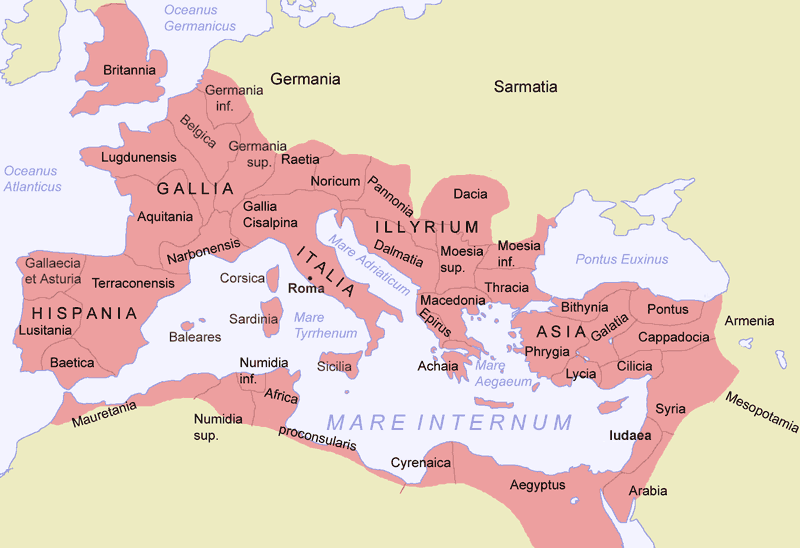
The distances , now no longer adjacent to easily accessible coastline, were making the cost of conquest prohibitive. More to the point, the enemies Rome faced as it grew larger were vast empires themselves and were more than capable of defeating the Roman legions.
It was at this point that Rome had reached a turning point: no longer would conquest be a significant source of revenue for the empire, for the cost of further expansion yielded no benefits greater than incurred costs. Conjointly, garrisoning its extensive border with its professional army was becoming more burdensome, and more and more Rome came to rely on mercenary troops from Iberia and Germania.
The result of these factors meant that the Roman Empire began to experience severe fiscal problems as it tried to maintain a level of social complexity that was beyond the marginal yields of it’s agricultural surplus and had been dependent upon continuous territorial expansion and conquest.

When Rome ceased its expansionist policy of conquest (blue) due to cold facts of cost/benefit, it lost a strong portion of its revenue (indicated by the orange ‘x’) for maintaining Roman Society. As a result, Roman emperors were forced to devalue Roman currency to simply maintain the status quo of the empire. Further economic policies included extremely excessive taxation of Roman peasantry in favor of the Roman urban citizenry and misguided attempts at controlling radical prices fluctuations. The effect of such policy, in conjunction with the intermittent barbarian raids of Roman countryside, was a gradual destruction of Rome’s capital resources: the rural population and its ability to procure sufficient energy to maintain an empire.
And as rural population declined, so too did urban population eventually follow suit:

This process of destruction of capital replaced the former action of conquest to maintain Roman social complexity (indicated in yellow):


The inevitable result of such continued policy was balkanization of the empire as not only did invasion establish new kingdoms, but so too did the Roman populace increasingly wish for relief of excessive taxation (which yielded ever decreasing benefits with the decline of the empire) in favor of simplification associated with local autonomy.
The fact is that Rome had reached a level of social complexity that it could no longer maintain. The empire was too large, had too great of a maintenance cost, with too many (increasing) problems (e.g. economic, productive, military) and too few (decreasing) resources to overcome them.
 IronHelix
 Plots and Complots